From 14-Year-Old Academy Kid to World Cup Winner: Inside Australia’s WBBL Pipeline
Category: Women's Cricket | Read time: 9 min read
Litchfield, Sutherland and Voll came off the WBBL production line. Private investment could finally turn that talent into a business.
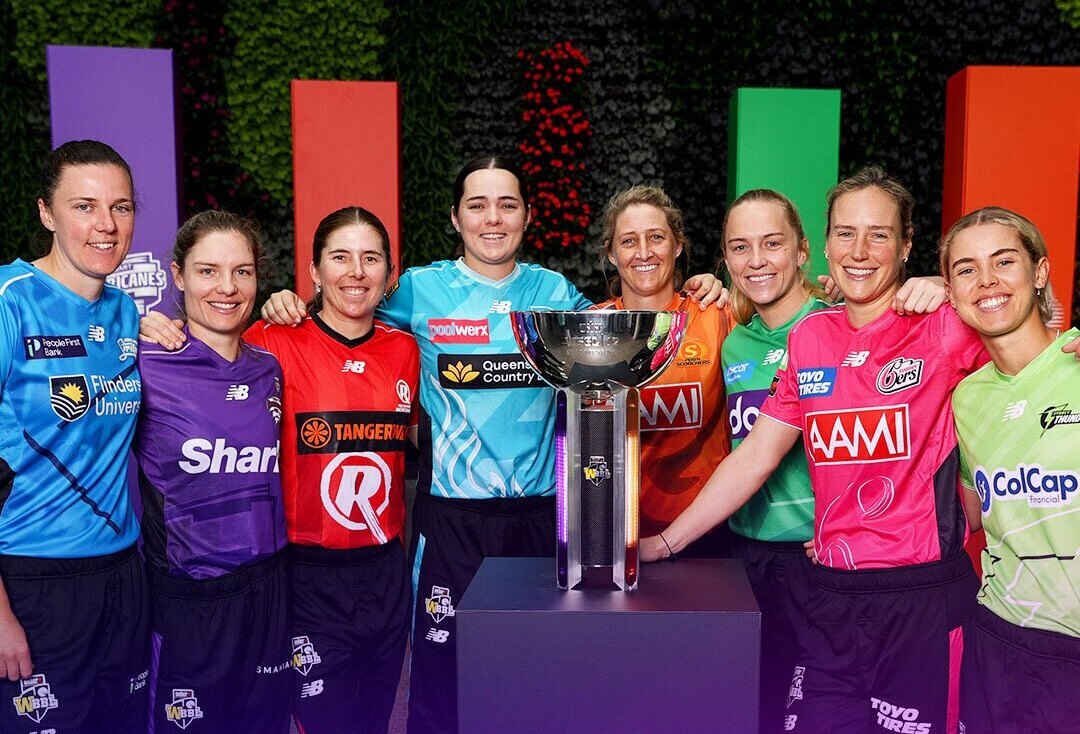
The WBBL Built Australia's Dynasty. Now Its Calendar Is Holding It Back
28,887. That was the crowd at Lord's in July when Australia chased down 151 against England to win a seventh Women's T20 World Cup, with Phoebe Litchfield and Beth Mooney doing most of the damage. Less than seven months earlier, the Women's Big Bash League (WBBL) had finished its 11th season averaging 1,547 spectators a game. Both numbers come from the same system. The WBBL is a big reason Australia keeps producing players like Litchfield, and according to Wisden's reporting on the Big Bash sale, it is also a league that still operates at a loss. With private money about to enter the Big Bash for the first time, and the men's season opening in Chennai, the question of where the WBBL sits on the calendar (and on the balance sheet) is no longer academic.
The WBBL is the best player factory in women's cricket. It has never had to work as a business that pays its own way.
Two Leagues, Two Summers
WBBL|12 runs from 29 October to 5 December: 43 matches over 38 days, opening with a double-header at Junction Oval. The men's BBL|16 starts on 12 December. The two competitions sit a week apart and never overlap.
That wasn't always the plan. For its first four seasons the WBBL ran alongside the men's league between December and February, often as double-headers. From 2019 Cricket Australia (CA) moved it into its own October to November window. The reasons were reasonable at the time. The women's game needed clear air away from men's internationals and the BBL, prime-time slots, and finals that stood as events in their own right rather than as curtain-raisers, which had drawn criticism. The window was also pitched as a launchpad for the 2020 T20 World Cup, whose final pulled 86,174 people into the MCG.
On television, it has largely worked. CA says WBBL|11 recorded the highest average audience per game (128,000) since every match began being broadcast. So is the separate calendar a commercial miss? Partly. The gate tells a different story to the ratings. Several WBBL|11 games drew fewer than 600 people, and the lowest crowd of the season was 275 in Hobart. Finishing in early December means the league misses the school holidays and the Christmas to January stretch where the BBL makes its money. Beth Mooney and Ellyse Perry have also raised the point that Australia's women play just nine home internationals this summer, none of them in the December and January holidays. Queensland Cricket chief executive Terry Svenson has gone as far as suggesting weekend-only fixtures and a return to double-headers.
The 2019 decision was sound. The problem is that it was never properly revisited once the women's calendar filled up around it.
What The Hundred Does Differently
England went the other way. Every women's match in The Hundred is played as one half of a double-header with the men's fixture between the same two teams at the same ground, and the whole thing is marketed as a single competition. In 2025 the women's competition set a global record for total attendance at a women's cricket event with 349,401 fans, including 22,542 at the final.
The model has limits. Loughborough University research found that nearly three in ten respondents had never watched women's cricket before going to The Hundred, but also that many of those fans did not go on to attend other women's matches. Double-headers buy exposure. They do not automatically buy loyalty.
The bigger gap is now financial. Wisden puts the total generated for English cricket by the Hundred stake sale at £945 million, and the first season under private owners showed what that means for players. Sophie Devine, in the top WBBL bracket last season on AU$110,000, was bought for £210,000 at this year's Hundred auction. Mooney's deal with Trent Rockets was worth around AU$400,000, more than three times the maximum WBBL contract.
Australia can't simply copy and paste the English model. The Women's Premier League (WPL) now sits in January, right on top of the BBL's peak weeks, so a full merge of the two Big Bash windows would collide with India's league. A partial crossover is possible, though, and is already being discussed.
The Hundred sells one competition with two halves. The Big Bash sells two competitions that happen to share a kit.
Chennai Gets the BBL. Why Not the WBBL?
On 12 December, the Melbourne Renegades play the defending champions Perth Scorchers at the MA Chidambaram Stadium. It will be the first BBL match played outside Australia and the first foreign league fixture staged in India. The game was announced at the MCG in July in front of Prime Ministers Narendra Modi and Anthony Albanese, as part of the India-Australia Sports Collaboration Roadmap. JioStar will broadcast it in India, while Seven and Fox Cricket take it back home after day four of the Perth Test against New Zealand. CA has been clear that this is not the start of a permanent base in Chennai.
The match opens doors for both boards. For CA, it is a direct line into the world's biggest cricket audience and the sponsors that come with it. It also strengthens CA's pitch to host IPL matches if the BCCI ever takes its league offshore. The timing helps too, since the Renegades licence is on the market and IPL-linked groups are among the interested buyers. For the BCCI, which had to sign off on the fixture amid reported concerns about protecting the IPL brand ahead of its 2027 rights cycle, it means a stronger alliance with the other major board and a ready-made overseas option if the IPL ever needs one.
CA hasn't publicly explained why the women's league wasn't part of the package. The likely answers are commercial. The deal was built around the product broadcasters and buyers already price highly. A league that loses money also feels travel costs more sharply. On paper, though, the women's case was arguably the stronger one. India's women are the reigning ODI world champions, and the WBBL has had an Indian connection since the BCCI first cleared its players for overseas leagues in 2016, with Harmanpreet Kaur at the Sydney Thunder and Smriti Mandhana at the Brisbane Heat. By 2021 the league had eight Indian players on its lists. A WBBL fixture in India would have taken an existing fanbase to a market that already knows the players. That chance is still there.
For Sale: One Licence, Two Teams
No WBBL team has been privately sold yet. On 8 September, CA approved a "self-determination" model that lets each state decide if and when to sell stakes in its clubs, and put a 100% stake in the Renegades licence on the market. That licence covers both the WBBL and BBL teams. Raine Group, which ran the Hundred sale, is handling the process. Cricket Victoria says 20 to 30 parties showed early interest, including up to six ownership groups linked to IPL franchises. The aim is to name a preferred owner by 12 December, with new ownership in place from 2027-28. Until then, CA runs the Renegades in caretaker mode.
The road here was messy. An earlier plan, which aimed to raise up to AU$600 million, was blocked by New South Wales and Queensland in April. The Hurricanes, Stars and Scorchers are reported to be open to investment, while the Sixers, Thunder, Heat and Strikers are understood to be reluctant. The players' association still claims 27.5% of any sale proceeds under the current pay deal, and that dispute is heading to arbitration.
For the women's game, the key detail is the bundle. CA reportedly looked at selling WBBL and BBL teams separately and quickly dropped the idea, because one makes money and the other doesn't. Former captain Alyssa Healy put the objection plainly: "Don't lob it in with the Big Bash, that's not fair." The risk is that the WBBL becomes an add-on to the men's asset. The opportunity is the flip side of that. An owner who has paid for both teams has every reason to make the women's side earn its keep, and shared windows and double-headers are one of the quickest ways to cut costs.
A buyer who owns both teams will not tolerate one of them losing money for long. That pressure could be the best thing to happen to the WBBL.
The Conveyor Belt
Whatever its commercial problems, the WBBL's output on the field is hard to argue with. Phoebe Litchfield debuted for the Sydney Thunder at 16 in the opening match of the first standalone season in 2019, and became the youngest player to score a WBBL fifty in her second game. She won a title at 17, became the league's youngest full-time captain at 21, and made 48 off 35 balls in the World Cup final at Lord's.
Annabel Sutherland was 15 when she played for the Renegades, the youngest WBBL player at the time. She has since become the first woman to score a Test century at the MCG (163 in January 2025) and has twice been ranked the world's No.1 T20I bowler, most recently in January 2026. Georgia Voll signed with the Heat at 16, debuted in WBBL|06 while still at school, and hit an ODI hundred in only her second match for Australia in December 2024.
The league has even produced players for Australia from outside Australia. Kim Garth first came to the WBBL as an Ireland player on the ICC and CA Associate Rookie Programme in its first season. She was part of the Sydney Sixers' title-winning squad the following year, and was in the Australian squad celebrating at Lord's in July.
The national results follow. Australia has won seven of the ten Women's T20 World Cups played and sits top of the ICC Women's T20I rankings on 292 points following its recent series win over New Zealand, 16 clear of second-placed England.
Why the Pipeline Works
Australia's edge isn't that it finds talent earlier than anyone else. It's that it puts that talent in an elite environment earlier. Western Australia's pathway is a typical example: state Under-16 and Under-19 teams at the national championships, a Youth Academy for 13 to 17 year-olds, an Academy for 14 to 20 year-olds, then a second XI, the 50-over Women's National Cricket League (WNCL), and the WBBL. Each step is clearly signposted.
The Big Bash clubs sit inside that system rather than beside it. Litchfield was 14 when she was named in the Thunder's WBBL Academy, which meant training with the senior squad and being in camp on match days. Cricket NSW's Emerging Player Program now switches to a T20 focus during the WBBL and embeds its players in the Sixers and Thunder academies. Earlier under-18 rookie placements gave national championship standouts two weeks inside a WBBL club, and several of those rookies went on to earn full contracts.
The money keeps those players in the game. Australia made its domestic women semi-professional in 2017, the first country to do so. The 2023 pay deal doubled the WBBL salary cap to about AU$732,000 per team, lifted the average player across the WNCL and WBBL to around AU$151,000 a year, and put most minimum contracts above AU$100,000. Around AU$20 million was also set aside for player wellbeing and Player Development Managers. Because the WNCL and WBBL draw on the same player pool, a teenager in either competition is facing internationals every week. That is why the jump to Australian colours looks so small when Litchfield or Voll make it.
Australia's real advantage is the distance between its domestic game and its national team. It is shorter than anywhere else in the world.
Inside a WBBL Week, and What Associates Can Take From It
During the season, a contracted WBBL player's week is built around two or three matches, plus the travel in between. The rest of the week is filled with gym and conditioning work, skills sessions, analyst meetings on match-ups, and recovery. Squads mix world-class internationals with state players and academy teenagers who may still be at school. Sutherland missed part of one WBBL season to sit her Year 12 exams, and Voll made her debut before she had finished school. Player Development Managers help players fit study or work around cricket, but since 2017 a domestic player's main job can simply be cricket.
Associate nations can't match Australia's budget, but most of the model does not depend on budget. Three parts travel well:
- Pay players enough to stop choosing. Even a modest combined national and domestic contract that frees players from full-time work during a short season changes how much they can train and recover.
- Put teenagers in the room early. A short, intense T20 window with an academy group training alongside senior players costs far less than a new league, and it is how Litchfield was fast-tracked at 14.
- Borrow someone else's elite environment. The WBBL's associate rookie placements, which in the early seasons brought in players from Ireland, Scotland, Thailand, Hong Kong, Papua New Guinea, the Netherlands and China, show the appetite exists. Associate boards that negotiate placements with established leagues get years of development for the price of flights and accommodation.
The 19 Yards Take
- An average of 128,000 TV viewers a game shows the WBBL product works. The 1,547 average crowd is a scheduling problem, and the fix starts with getting at least part of the league into the December and January window where the BBL makes its money.
- Up to six IPL-linked groups are looking at a licence that includes a women's team. The WBBL side should be priced and pitched to them as a growth asset in its own right, with its own commercial plan, not as a cost that comes bundled with the men's club.
- A six-week rookie placement helped set a 19-year-old from Ireland on the road to a World Cup title with Australia. Associate boards that build placement deals with established leagues now will be the ones producing the next Kim Garth.
Calendar windows, rights packaging, ownership models and talent pathways can look like four separate problems. In Australia this summer they have become one decision, and the way it is made will shape the WBBL for the next decade. 19 Yards works across all of it, from how a league is scheduled, packaged and sold, to how investors are brought in, to how a pathway turns 14-year-olds into internationals, at every level of the game. Whether you run a league, a franchise or a national federation trying to build your own version of Australia's system, the same questions apply to you.
If your organisation is weighing any part of that, talk to 19 Yards. Australia has shown how to build world-class players. The next test is building a league that can pay for them, and that is exactly the work we do.