The Retirement That Isn't: Cricket's New Career Ladder
Category: Commercial Strategy | Read time: 9 min read
Muhammad Waseem, Ross Taylor, David Wiese, Corey Anderson: four different boards, four different reasons to switch flags, and a breakdown of what each move actually bought their new team.
The Best Career Move in Cricket Right Now Is Leaving
Nicholas Pooran retired from international cricket on 10 June 2025. He was 29, the vice-captain of West Indies' white-ball side, and had just finished a calendar year in which he hit more T20 sixes than any batter alive. His body wasn't failing him and his form wasn't either. He left because Cricket West Indies' best available contract, somewhere between $150,000 and $300,000 a year even for a multi-format player, was a fraction of what Lucknow Super Giants alone were paying to retain him for one IPL season, a reported ₹21 crore, before Major League Cricket and CPL money is even added. Pooran didn't quit cricket. He quit the employer paying him the least for it. That arithmetic, not sentiment, is the real story behind the sport's busiest transfer window: the one that never officially opens.
Nobody in this story is quitting cricket. They're quitting the version of it that pays them worst.
The Names on the Departures Board
Pooran isn't alone, and the reasons on record are worth reading properly rather than waving off as "load management."
- Trent Boult asked New Zealand Cricket to release him from his central contract in August 2022, telling the board plainly it was "about my wife Gert and our three young boys." NZC warned him it would shrink his chances of national selection. He accepted that trade and kept playing franchise cricket on his own terms.
- Jason Roy gave up his ECB central contract in 2023, not to leave England behind but to remove the restriction that came with it, freeing him to join Major League Cricket's LA Knight Riders and continue at Kolkata Knight Riders in the IPL, while still calling England his "priority."
- James Anderson, England's most capped fast bowler, registered for the IPL 2025 mega auction at 42 after retiring from Tests. He went unsold. Worth including precisely because it undercuts the romantic version of this story: the leagues don't pay for a famous name, they price current form.
- Andre Russell retired from international cricket in July 2025, then from the IPL itself that November, ending a twelve-season run with Kolkata Knight Riders. He didn't disappear either time. He joined KKR's coaching staff as their "power coach" for 2026 and said so himself: "I'll still be smashing sixes and taking wickets in leagues around the globe."
- Faf du Plessis stepped away from Test cricket in 2021 specifically to "play as much [T20 cricket] as possible around the world," and has been a fixture across the IPL and MLC circuits ever since, most recently as captain and co-owner of Rotterdam in Europe's inaugural ETPL season this year.
Different boards, different players, the same calculation repeating: international cricket now asks for the most time and, for most of these players, pays the least of the three options in front of them.
New Flag, Bigger Job
Money explains half of this trend. The other half is opportunity: a player who would spend his best years fighting for a place in a stacked national side instead becomes the player his new team is actually built around.
Muhammad Waseem was born in Mian Channu, a small Punjab city, in a country that produces more genuine fast-bowling and top-order talent than its own domestic system can fit into one XI. He moved to the UAE, qualified under the ICC's three-year residency rule in 2021, and was made national captain within two years. He led the UAE at the 2026 T20 World Cup, top-scoring with 66 against New Zealand in a group stage that also produced a breakthrough for 21-year-old Aryansh Sharma, who moved to the UAE from Ghaziabad at age two and hit an unbeaten 74 against Canada. Neither of those careers looks the same stuck in a queue behind Pakistan's or India's first-choice XI.
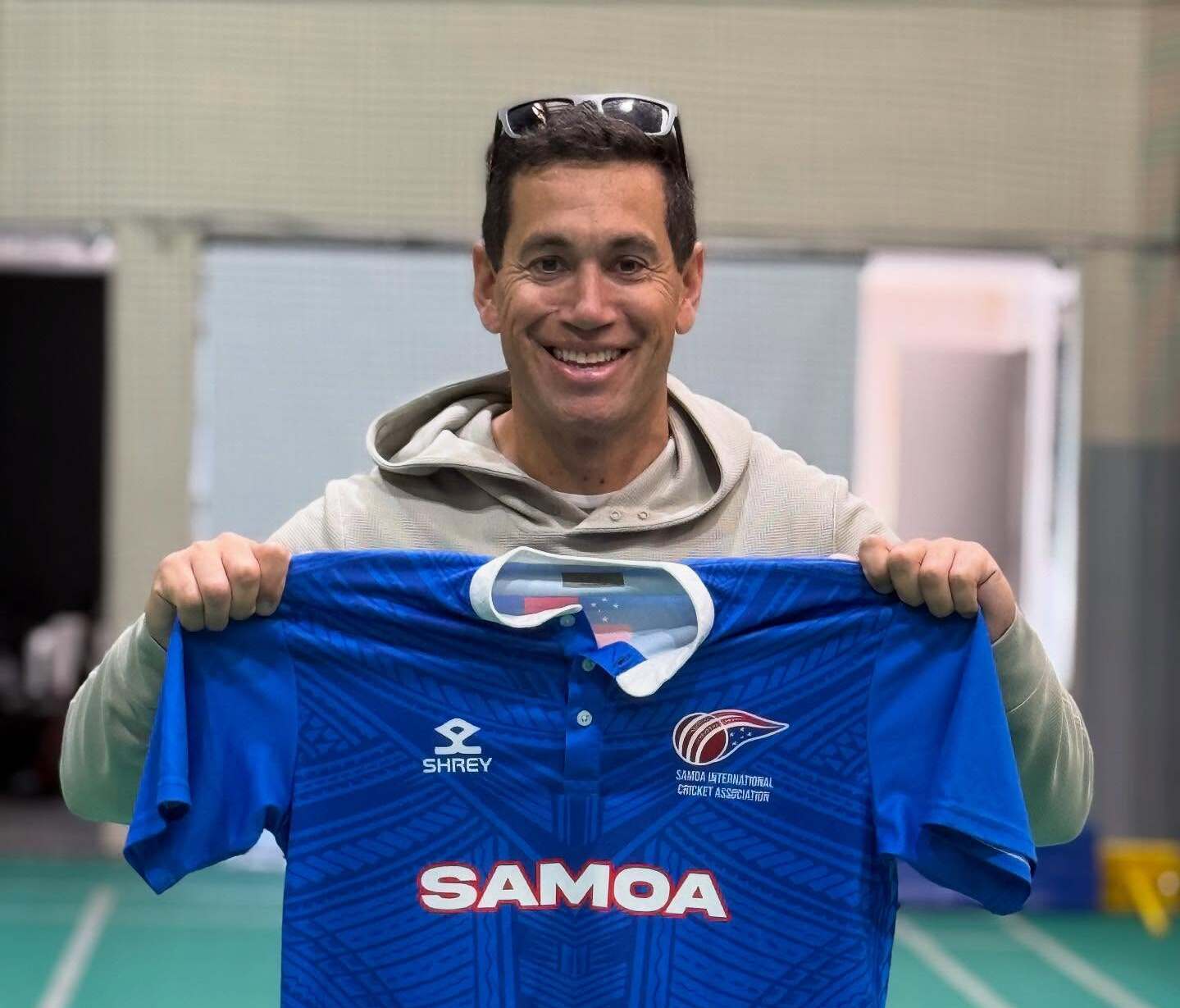
The same logic holds even when the move has nothing to do with money. Ross Taylor, New Zealand's former captain, came out of retirement in September 2025 to play for Samoa, his mother's homeland, at the T20 World Cup regional qualifiers. Samoa didn't ultimately reach the main tournament, but they beat regional rival Papua New Guinea to advance to the Super Six stage, a level of competitiveness the Pacific nation had rarely shown before Taylor's arrival raised the team's profile and its standard in training. David Wiese made a similar heritage-based switch, leaving a South African career behind to represent Namibia, the country his father was born in, debuting at the 2021 T20 World Cup once his Kolpak deal with Sussex ended and Namibia's coaches came calling again. He's been central to Namibia's rise ever since, including a Super Over win over Oman at the 2024 tournament, and has used his experience to talk up young Namibian teammates like JJ Smit and Gerhard Erasmus rather than simply occupying their spots. Corey Anderson, once a senior New Zealand international, requalified for USA and was part of the side that beat Pakistan in a Super Over in Dallas at the 2024 T20 World Cup, a result that pushed USA into the Super Eights on debut as co-hosts.
Taylor, Wiese and Anderson didn't find easier cricket by switching flags. They found teams willing to build around them instead of past them.
What The Number Actually Buys
Go back to the money, because it explains the skill argument too. Franchises entered the IPL's 2025 mega auction with roughly ₹120 crore to spend each, on top of anything already committed to retained players. Cricket West Indies' own central contracts, by comparison, run from about $150,000 to $300,000 a year even for a multi-format player, nowhere near what a single IPL retention pays. Boards without that kind of money were never going to out-bid the leagues. They can only out-build them, on pathway and identity, which is the part most of them haven't tried yet.
The skill-development case is less discussed but just as real. A player doing the rounds of the IPL, MLC, CPL, ILT20 and one or two more leagues in a calendar year faces a wider range of bowling attacks, batting orders and data-driven coaching setups in eight months than a bilateral-heavy international calendar offers in two years. James Anderson going unsold at 42 is the useful corrective here: the leagues aren't charity for old flags, they're competitive markets that drop players the moment the returns don't justify the price. That discipline is, in its own way, a harder school than a guaranteed national contract ever was.
The Pipeline Behind The Comeback
For a promising young player, the direct benefit of all this movement is game time, but only where a board has deliberately built a bridge for it rather than just hoping one appears.
Cricket West Indies launched the inaugural West Indies Breakout League in April and May 2025: six territorial teams, each tied to a Caribbean Premier League franchise, restricted to players 30 or under with fewer than 40 List A or domestic T20 matches and fewer than 10 international T20 caps. It exists for one reason, to give the next generation minutes that senior stars, now playing four leagues a year, would otherwise soak up by default.
The DP World ILT20 runs a version of the same idea in the Gulf. Its Development Tournament, now in its fourth season and recently expanded to include Kuwait, exists specifically to feed young, largely UAE-qualified players into the ILT20 auction. Former DP World ILT20 CEO, David White has credited it with lifting "not only their skills, but also their attitude, their strength and conditioning, the whole level of professionalism." Across its first three seasons it produced more than fifteen graduates into the main ILT20 or international cricket, Aryansh Sharma among them, the same young batter who went on to top-score for the UAE against Canada at the 2026 World Cup. That's the model working as intended: a returning or naturalised senior star doesn't block the pathway, he sits inside a structure that keeps producing the next one anyway.
What Home Boards Should Actually Be Doing
West Indies coach Daren Sammy said publicly, after Pooran's retirement, that more players would follow. Cricket West Indies didn't just accept that, it built around it: specialist coaches shared across the system, mandatory individual development plans for every player on a franchise deal, a regional fitness leaderboard so the board can track its own players wherever in the world they're contracted, and a new high-performance centre in Antigua, on top of a formal mentorship framework pairing capped and contracted players with emerging talent. Namibia and the UAE have reached similar conclusions from different starting points, leaning on a small pool of heritage or naturalised veterans specifically to mentor a much younger core rather than simply replace it.
Sammy said more players would follow Pooran out the door. Cricket West Indies' response was to build the door into a bridge instead.
Andre Russell's move into a "power coach" role at Kolkata Knight Riders is worth every board studying, even though it happened inside a franchise rather than a national setup. It's proof that a genuine second career, not a rocking chair and not a commentary booth, is exactly the kind of offer that keeps a player's knowledge inside a system instead of losing it entirely to retirement. Boards that build the equivalent in-house won't stop every departure. They will stop losing the value a departing player still has to give.
The Playbook for Boards Recruiting From Elsewhere
The flip side of this trend is the board on the receiving end: recruiting naturalised citizens, heritage-eligible players, or requalified veterans to compete now. Done well, it works. The UAE, Namibia, Samoa and USA have all reached tournaments or results their domestic pipelines alone would not have produced as quickly. Done carelessly, it becomes a five-year loan against a country's own cricket, fielding a senior team that looks nothing like the junior one beneath it, and associate boards have already faced criticism for stretching selection rules to fit an eligible import in rather than the other way round.
The fix isn't complicated, even if it's rarely written down as policy. Run the recruitment strategy next to a visible, funded junior pathway, not instead of one, the way the ILT20's Development Tournament sits underneath the UAE's senior side, or the way Namibia's Wiese has made a point of naming and promoting the young players around him rather than just occupying a batting spot. Publish clear, consistent criteria for how a naturalised, heritage-eligible or requalified player earns selection, since vague or informal rules are exactly what draw criticism when a promising local player gets bypassed. And treat every recruited senior as a mentor by design, not a stopgap starter, so that whichever route brought them onto the team, residency, ancestry or a change of passport, also puts their experience directly in front of the players who will eventually replace them.
The 19 Yards Take
- Cricket West Indies built a Breakout League tied straight into CPL franchises; the DP World ILT20 built a Development Tournament that's already produced fifteen-plus graduates. Boards without an equivalent bridge into their own domestic or franchise league are just waiting for their own Pooran, or their own Waseem, to walk out the door.
- A $300,000 national contract cannot out-argue a ₹21 crore retention, and boards that keep trying to compete on that number will keep losing the argument. The ones building real second careers, the way Kolkata Knight Riders just did with Andre Russell, keep a player's value in the system even after the playing days end.
- Naturalisation and heritage recruitment only pay off long-term when they sit next to a visible junior pathway, whether that's the UAE's development league or Namibia's senior players actively mentoring the next Erasmus or Smit. Running one without the other is borrowed time, not a strategy.
Retirement in cricket was never really the end of anything. It's a renegotiation, of pay, of role, of which flag gets a player's best remaining years. Boards that treat every departure as betrayal will keep losing the argument to whoever's writing the bigger cheque or offering the better role. The ones treating it as a design problem, whichever region they're in, end up with deeper squads than their neighbours and a pipeline that outlives any single comeback story.
If your organisation is trying to build that kind of pipeline, rather than reacting to the next high-profile departure or comeback, talk to 19 Yards. We work with boards, leagues and franchises on the commercial and development structures that keep talent inside the system, wherever in the world it happens to be playing right now.