Last-Ball Heroics, Twice: The Rise of Nigeria's U19 Women
Category: Women's Cricket | Read time: 9 min read
Two nail-biting finishes, two World Cups and full university scholarships for the whole squad. Nigerian cricket has found its golden generation.
Breakthrough to Programme: How Nigeria's Girls Rewrote Their Own Timeline
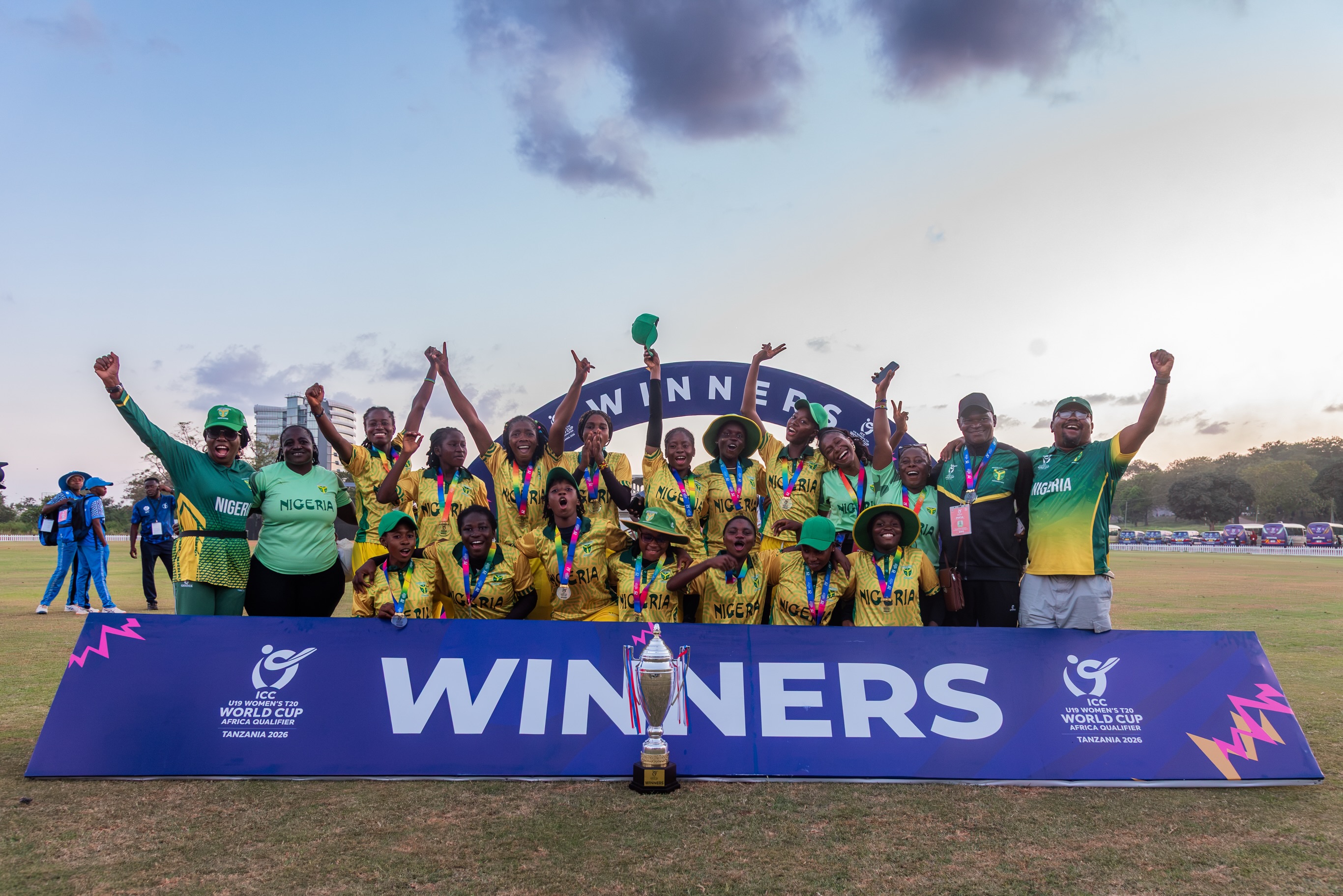
Ninety-eight. That was all Nigeria's U19 women had to defend against Zimbabwe in the Africa Qualifier final in Dar es Salaam on 5 September 2026, with one ticket to the 2027 ICC U19 Women's T20 World Cup on the line. They won by four runs, with one ball to spare, capping an unbeaten tournament and sending Nigeria to a second straight World Cup. Nigeria Cricket Federation president, Uyi Akpata had once pencilled in 2028 as the year a Nigerian women's team would reach a World Cup. "We are achieving these milestones three years ahead of schedule," he said. The more interesting question is no longer whether Nigeria can produce a surprise. It is whether what sits behind the surprise can keep producing them.
One World Cup is a breakthrough. Two in a row, the second one unbeaten, is a programme.
The difference matters. Emerging cricket is full of breakthroughs: one golden batch, one famous win, then a slow fade when those players age out. A programme is different. It brings players back, replaces the ones who leave, gives them a reason to stay and a level to step up to. On the evidence of the last 20 months, Nigeria is building the second thing.
The Breakthrough: Kuching, 2025
Nigeria arrived in Malaysia in January 2025 as debutants almost nobody had watched, having won the 2024 Africa Qualifier in Kigali without losing a game. Their opener against Samoa was washed out. Their first real taste of a World Cup came against New Zealand in Kuching.
Rain cut the game to 13 overs a side, and captain Lucky Piety hit the first six a Nigerian player had ever struck at a World Cup. It came down to the last ball, with New Zealand needing five. Annointed Akhigbe fired the ball back from the deep to keeper Deborah Bassey, the stumps were broken with the batters scrambling for a third run, and Nigeria won the game by two runs. Lillian Udeh, who bowled that nerveless final over, was named Player of the Match. It was the country's first win at any women's World Cup, and it came against a Full Member.
Nigeria's first ever World Cup win came down to a run out off the final ball. Nobody who saw it has forgotten it.
South Africa, who went on to reach the final, gave them a tougher day a few days later, but Nigeria still made it through to the Super Six. The rain followed them there too, washing out their game against England, before they signed off in style with a win over Ireland. In the end, a single point stood between Nigeria and the semi-finals. Not bad for a first go. "First time at the World Cup is no joke," head coach Sarah Bakhita said, adding that the team wanted to "make a statement and finish strong." They did both.
The Programme: Dar es Salaam, 2026
Qualifying again was the real test, and Nigeria passed it without dropping a game. Eight teams went to the TCA Arena at the University of Dar es Salaam, and only the winner would join South Africa as Africa's representatives in the 2027 U19 World Cup. Nigeria won all five matches.
The final was a lesson in holding your nerve. Batting first, Nigeria scraped to 98 for 6, with captain Christabel Chukwuonye top-scoring. Pacers - Peace Usen and Jennifer Godwin kept squeezing, and Zimbabwe were bowled out for 94 in the final over. "I actually cried when the game was over," Chukwuonye said. "Even with the pressure in the last over, they were able to hold their nerves."
Look at who was on the field and the programme shows itself. Usen, Akhigbe, Bassey, Omosigho Eguakun and Chukwuonye all played in Malaysia and were back in Tanzania, with Eguakun finishing as the tournament's best batter and Chukwuonye stepping up from contributor to captain. Bakhita was still in charge. The experience from Kuching went straight back into the next cycle instead of walking out the door.
Then came the detail that says most about intent. Every member of the squad was handed a full scholarship through to the end of university. "The commitment extends beyond immediate rewards," Akpata said. "We want these players to continue excelling academically while developing as athletes." For a parent deciding whether a daughter should spend her teens on a cricket field, that promise may be worth more than the trophy. It is also how a programme keeps its players.
Breakthrough vs. Programme
Nigeria has played cricket since at least 1904, when Lagos Colony met the Gold Coast at the Race Course in Lagos, but the game faded in the late 1970s as football took over and many of its grounds were left to ruin or built over. The modern rebuild started with ICC Associate Membership in 2002. Its first big payoff was the men's U19 side reaching the 2020 World Cup in South Africa, the first time a Nigerian team had played at a cricket World Cup. The U19 women made it two in Malaysia. 2027 will be three.
What powers this programme is volume. By Akpata's account in a 2023 interview, cricket grew from 20 schools nationwide to more than 100, with between 100,000 and 200,000 children playing at school level. The national U15 championships draw 36 boys' and girls' teams a year, with a U17 championship above that. The federation employs 45 full-time development officers, at least one per state, and the 2026 U19 squad was picked through several zonal camps before a final assessment in Benin City. Akpata's stated goal is to make cricket "the number two sport in the country, just behind football," bringing 250,000 new young players into the game every year.
The rungs above are being built too. The inaugural Nigeria Super League ran through the second half of May 2026, six franchises and 20 matches ending in a final at the TBS Cricket Oval in Lagos, won by the Middle-Belt Tigers. The same month, the NCF appointed Zimbabwean coach Stephen Mangongo as head coach and high-performance manager on a three-year contract, with the goal of a Nigerian team at a World Cup in 2028.
And the next intake is already being widened. In June 2026, the ICC named Nigeria as Africa's regional winner for Associate Member Women's Team Performance of the Year, and in July the NCF won the global ICC criiio Cricket Festival of the Year with Rexona award for "Breaking Barriers," a festival that took cricket to girls in Zamfara State, where access to sport and education has historically been limited. Zamfara didn't win this qualifier. The squad came through the existing age-group pathway. But the scholarships and the festival are two ends of one policy, and the U19 World Cup players of the 2030s may well come from it.
The Road to Bangladesh and Nepal
The 2027 edition, the third U19 Women's T20 World Cup, will be co-hosted by Bangladesh and Nepal with 16 teams in the draw. India have won both editions so far. The regional qualifiers have produced a lively field: Samoa through East Asia-Pacific, the UAE by a single run over Malaysia in the Asia final, the USA unbeaten in the Cayman Islands, and Nigeria from Africa alongside South Africa, with the last remaining place going to Europe's qualifier. This time, nobody in the draw will be treating Nigeria as a surprise.
What a Programme Still Needs
There is one test a programme has to pass that no scorecard measures: whether it can pay for itself. Here Nigeria's foundations are growing but still modest. In 2023 the federation counted seven quality turf wickets in the country. By March 2026 it was pointing to completed ovals in Abuja, Lagos, Ibadan and Edo, plus an indoor facility at TBS for year-round training, but the rains still shut much of the game down from June to September. Akpata has spoken about moving the federation away from relying on government funding and towards lasting partnerships.
Some partners have already found their way in. Providus Bank backed this year's women's invitational in Lagos as headline sponsor, saying it "identified with the values that cricket is promoting... resilience, team spirit, and tenacity." Edtech company uLesson partnered the national U17 championship in 2023. A team that has beaten New Zealand, qualified twice and sends its players to university is the kind of story that tends to find friends. The ones who arrive before Bangladesh and Nepal will be part of it from the start.
Nigeria built the team first. Everything else, the pitches, the partners, the audience, now has a reason to follow.
The 19 Yards Take
- A run out off the last ball in Kuching and 98 runs defended in Dar es Salaam: two of the best finishes in junior women's cricket in 20 months, by largely the same core of players. That continuity is the programme.
- Full university scholarships for a whole squad turn a cricket pathway into an education pathway. Every parent in the country understands that offer, and so does every brand that cares about young Nigerians.
- A handful of turf wickets, however fast new ovals are going up, can't yet carry a target of 250,000 new players a year. Closing that gap is what turns a strong programme into a permanent one.
Nigeria has done the part that can't be bought: it found the talent, kept it together and built a team that wins under pressure, twice. What decides whether this becomes a permanent force is the commercial layer around it, and that is the work 19 Yards does every day.
Associate cricket is our home ground. We know how it works from the inside: how ICC funding cycles and regional qualifiers shape a board's year, how a development award or a World Cup run can be turned into a partner conversation, and how to get things done with the small teams and tight budgets most federations run on. We have built relationships across associate boards, regional cricket bodies and the brands that invest in the game, and we have established ways of working that fit the way these organisations actually operate. That lets us move quickly on the things that matter most in a moment like Nigeria's: packaging a women's or youth team as its own partnership property, building a commercial model for a young domestic league, and putting together the investment cases that get grounds, facilities and pathways funded.
If your federation has a breakthrough and wants to turn it into a programme, talk to 19 Yards. We have been in the room for this before, and we know what comes next.