Exposure Is the Missing Ingredient: Building Associate Cricket Between World Cups
Category: Emerging Markets | Read time: 10 min read
The talent gap is closing. The fixture gap isn’t, and that’s where boards, tours and brands need to focus next.
Associates Don't Need More Moments. They Need a Calendar.
Nine Associate nations went to the 2026 men's T20 World Cup in India and Sri Lanka, Scotland among them as a late replacement for Bangladesh. Not one of the nine beat a Full Member, and none made it out of the group stage. At every T20 World Cup from 2014 to 2024, at least one Associate had reached the second round, most recently the USA, who made the Super Eight in 2024. That streak ended in 2026. Now go back to 2025. In May 2025 the UAE beat Bangladesh 2-1 in a T20I series in Sharjah. In September, at the same ground, Nepal beat the West Indies 2-1, including a 90-run win that is still the biggest by an Associate over a Full Member. Largely the same Associate players, the same format, very different outcomes. The difference was not talent. It was repetition.
A World Cup is an exam. Associates are being asked to sit it without attending the classes.
The Calendar Problem: How Much Cricket Do Associates Actually Get?
On paper, the Associate calendar looks busy. Look closer and the depth changes sharply by gender and format.
- Men's 50-over: the deepest structure in the game outside the Full Members. Cricket World Cup League 2 wrapped up on 4 November, after each of its eight teams played 36 ODIs across the 2024-26 cycle. The USA finished as champions, and Scotland, the Netherlands and Oman also went straight through to the 10-team Qualifier, with Oman edging Namibia on net run rate. Namibia, Nepal, Canada and the UAE now go to the Qualifier Play-off alongside four sides from the 12-team Challenge League. The Qualifier will settle the last four places at the 14-team 2027 World Cup. All eight League 2 sides are Associates, so not one of its 144 games was played against a Full Member.
- Men's 20-over: sub-regional and regional qualifiers every two years lead into a 20-team T20 World Cup, which had nine Associates in 2026. In Asia, the ACC Premier Cup decides who reaches the Asia Cup and the Rising Stars event adds a few games against Full Member A sides. Bilateral series against Test nations remain rare and largely ad hoc.
- Women's 20-over: the fastest-growing calendar. Regional qualifiers feed a 10-team Global Qualifier and a 12-team World Cup, and since 2025 the ICC has added two annual events: the Emerging Nations Trophy and the ICC Women's T20I Challenge Trophy, a five-team event for the best regional sides outside the Emerging Nations Trophy, first played in Kigali this April. All of it feeds the ICC's plan to expand the Women's T20 World Cup to 16 teams from 2030.
- Women's 50-over: close to empty. Only a handful of Associate women's teams hold ODI status, the ICC Women's Championship is contested by Full Members, and the main door into meaningful 50-over cricket is the World Cup Qualifier. In 2025 that meant six teams, Scotland and Thailand among them, fighting for two places.
Associate men get plenty of cricket, mostly against each other. Associate women get more T20 cricket than ever but almost no 50-over cricket. Neither gets regular games against the teams they are expected to beat when it matters. Scotland played just seven T20Is outside qualifying events between the 2024 and 2026 World Cups, and only three of those against a Full Member, a home series against Australia in September 2024.
Nepal's case is starker. Their first bilateral series against a Full Member came only in September 2025, because Cricket West Indies agreed to it. Nepal have still not hosted a full tour by a Test nation. Captain Rohit Paudel used the World Cup to make the point publicly, telling the big boards to "come to Kathmandu, at the TU International Cricket Stadium, and play with us."
Exposure Works. The Results Already Prove It.
The biggest men's results of the last 18 months came in bilateral series, where Associates had a run of games against the same stronger opponent rather than a single shot.
Nepal beat the West Indies for the first time in the series opener, then bowled them out for 83 two days later. The Caribbean side was not at full strength, and they won the dead rubber by 10 wickets, but Nepal still became the first Associate to beat the West Indies in a bilateral series in any format. The UAE, 1-0 down to Bangladesh, chased 206 in the second game and sealed the series in the third. It was only their second T20I series win over a Full Member, after Ireland in 2021. In the women's game, Scotland beat Ireland by 40 runs at Old Trafford at this summer's T20 World Cup, the standout Associate result of the tournament.
The 2026 men's World Cup tells the other half of the story. Nepal lost to England by four runs after failing to score 10 off Sam Curran's final over. The USA had India 77 for 6 before Suryakumar Yadav rescued them. Defending 147, the Netherlands had Pakistan seven wickets down before Faheem Ashraf's 29 off 11 balls took them home with three balls to spare. Debutants Italy fell 24 runs short of England's 202, despite hitting 13 sixes, a record for an Associate against a Full Member at a T20 World Cup. Canada's 19-year-old Yuvraj Samra made 110 off 65 balls against New Zealand, the first T20 World Cup hundred by an Associate player, in a losing cause. Every one of those games was there to be won and slipped away in a handful of overs.
That is exactly what exposure fixes, in three practical ways:
- Decision-making at the death. Close games are won by players who have been there before against that quality. One World Cup every two years is not enough reps.
- Belief built over time. Thailand's women played Asia Cups from 2012 before their first win over a Full Member, against Sri Lanka in 2018. Breakthroughs rarely come on the first attempt.
- Visibility. Franchise scouts and county recruiters watch performances against Full Members, and those contracts are where Associate players earn a living.
Close losses are data. Wins are a habit. Habits need fixtures.
Who Keeps Beating Full Members? Look at the Dutch.
If one Associate has turned upsets into a track record, it is the Netherlands. They beat England at the 2009 and 2014 T20 World Cups, knocked South Africa out of the 2022 edition, and beat both South Africa and Bangladesh at the 2023 ODI World Cup, a tournament they qualified for ahead of the West Indies, Ireland and Zimbabwe. This year their women played their first T20 World Cup, and their men finished in the top three of League 2 to book a place at the 2027 Qualifier.
The Dutch got there by plugging their players into professional systems they do not own. For years they played in England's domestic one-day competitions against the counties. Their squads blend homegrown players with players of South African heritage such as Roelof van der Merwe, and coach Ryan Cook is South African too. Van der Merwe's Dutch passport also let him play county cricket for Somerset as a local player. When the Netherlands cannot get Full Member fixtures, they send their players to where Full Member cricket is played.
Nepal is the current-form answer, and the Kathmandu Post recently called them the Associate most consistently giving Full Members a run. But at the World Cup they lost to debutants Italy by 10 wickets and to the West Indies, the team they had beaten in Sharjah, by nine wickets. Momentum built on one series a year does not hold. The Dutch model is constant. Nepal's still depends on someone saying yes.
The Associates Building Something Real, and How They Keep Their Players
The Netherlands are the established model. A newer group is catching up, and what they share is not money. It is structure: players paid enough to stay, a clear route from school to the national team, and fixtures worth training for. Under the ICC's 2024-27 model, Associates share 11.19% of central revenue, around $67 million a year across more than 90 boards, so most of that structure has to be built at home.
Nepal now contracts 38 men and 25 women, on monthly salaries from Rs 25,000 to Rs 150,000 plus match fees. Only three men sit in the top grade, worth a little over US$1,000 a month, and the top women's grade is Rs 55,000. Modest by global standards, but enough to keep players in the game. Provinces add a layer underneath: Madhesh signed nine players left off the 2025 central list. Add the Nepal Premier League and some of the loudest crowds in the sport, and the only missing ingredient is fixtures.
Thailand are the benchmark in the women's game. The board began offering contracts in the early 2010s to stop players from poorer rural backgrounds dropping out, runs school-based centres with residential coaches, and gives academy players full scholarships through to university. The result was the inaugural Emerging Nations Trophy title last year.
The USA have built the clearest ladder. Minor League Cricket has produced players such as Saiteja Mukkamalla and Sanjay Krishnamurthi who have moved into Major League Cricket and the national team. The men finished top of League 2, which ended this week, and the women won the first Challenge Trophy with six wins from eight.
Indonesia shows what a regional system can do. Provincial teams competing at the national sports week pay their players, the women's squad trained together in a Bali residency borrowed from Thailand, and this year they played their first Women's Asia Cup.
Also worth watching: Italy, whose debut was built on heritage players and an experienced coaching staff; Namibia, co-hosts of the 2027 ODI World Cup who still have to come through the Qualifier Play-off to play in it; and Rwanda, whose women beat the USA by one run at the Challenge Trophy on home soil.
The lesson for keeping young players in the sport is practical. A teenager can commit to cricket when they can see the next 12 months of fixtures and a contract at the end of the ladder. Add dual-career partnerships, where a local bank, telco or university employs players on flexible terms, and cricket stops being a choice made against a career.
More Series, Smarter Tours: What Associates Should Be Chasing
Should there be more bilateral series between Full Members and Associates? Yes. But a request framed as a favour rarely wins a slot in a calendar already built around Full Member broadcast deals. The fixtures that actually get made are the ones that also suit the bigger board. Five ideas pass that test.
1. Add a stop to tours that are already happening
This is the cheapest option for a Full Member. When a Test nation is already travelling to a region, it plays two or three T20Is against a nearby Associate on the way. Nepal's breakthrough is the proof. Their series against the West Indies was played in Sharjah from 27 to 30 September 2025, days before the West Indies began a Test tour of India on 2 October. The West Indies used a separate T20 squad and slotted the series in ahead of the Tests. Nepal got the series they had waited years for. Any Full Member heading to the Gulf, South Asia or Southern Africa could do the same.
2. Use the UAE as a neutral home
Both of 2025's landmark series were played in Sharjah. The grounds are international standard, the time zone suits South Asian broadcasters and the expatriate crowd turns up. For Associates who struggle to host, it is a venue ready to go.
3. Send A teams to off-season tournaments
Darwin's Top End T20 Series runs during the Australian winter and mixes Big Bash academy sides with international teams. Nepal debuted in 2025, and that edition recorded 7.28 million digital views from Nepal alone. This August, Nepal A played alongside New Zealand A and Bangladesh's high-performance squad. Events like this give Associate players game time against Full Member talent without anyone giving up an international window.
4. Train inside Full Member systems
Nepal prepared for the World Cup with camps in Sri Lanka and India. That costs the host little and is worth a great deal to the visitor. Experienced coaches carry the same knowledge across: Stuart Law runs Nepal, Gary Kirsten consults for Namibia and Lalchand Rajput coaches the UAE.
5. Write Associates into franchise leagues
Leagues can guarantee exposure where boards cannot. For its fifth season, the ILT20 requires every franchise to carry at least four UAE players, including one capped and one under-23 player, with two in every starting XI, plus one player from another Associate nation in each squad. That puts UAE cricketers alongside international stars for a month every year.
When Associates arrive at a World Cup having already played Test nations a dozen times, four-run losses start becoming four-run wins, and the match-ups the ICC sells to broadcasters get genuinely better. Someone still has to pay for those fixtures, which is where brands come in.
Selling the Pathway: Why Brands Should Buy In, and Who Already Has
Exposure is not the same as monetisation. Sony's eight-year, $170 million deal for ACC events through 2031 is one of the most valuable pathway properties in the sport, but India, Pakistan and Sri Lanka drive that value, not Nepal or the UAE. Associates cannot wait for central deals to trickle down. They have to sell their own inventory.
Some brands are already buying. Capricorn Group has committed N$1.2 million over two years to Namibia's women's and girls' cricket, covering naming rights to the national team, the Capricorn Eagles, plus the Under-19s, girls' festivals and a girls' schools league. In Nepal, Extreme Energy Drink signed the biggest deal in the women's team's history in January and has since become title sponsor of six Nepal Premier League teams. NAASA Securities backs the men's team on a three-year deal worth about US$545,000.
For boards chasing the next deal, the pitch should rest on four things:
- Sell audiences, not causes. Nepal were the only team to play all their World Cup group games at one venue, the Wankhede, in front of huge travelling support. Around 20,000 fans turned up at Chepauk for a game between two Associates. Those are marketing numbers.
- Sell the whole ladder under one name. The Capricorn Eagles model gives a sponsor one story from schoolgirls to the national team. Extreme's mix of a national team and six franchises shows the same logic.
- Price on data. Fitzgibbon's Wisden piece argues Associates should track revenue per fan rather than views. Owned fan data makes every renewal easier.
- Never rely on one backer. The European Cricket Network had channelled around £4 million to European boards before Dream11's exit, after India's gaming ban, forced it to pause all events in August 2025.
The wider market is shifting too. Since 2025, ICC women's events have carried their own standalone sponsors, with Unilever signed as a partner, a sign brands now see this part of the game as an investment rather than a subsidy.
Brands don't sponsor potential. They sponsor audiences. Associates already have them. Most just haven't packaged them yet.
Ajman, 12 November: The Next Test Starts Next Week
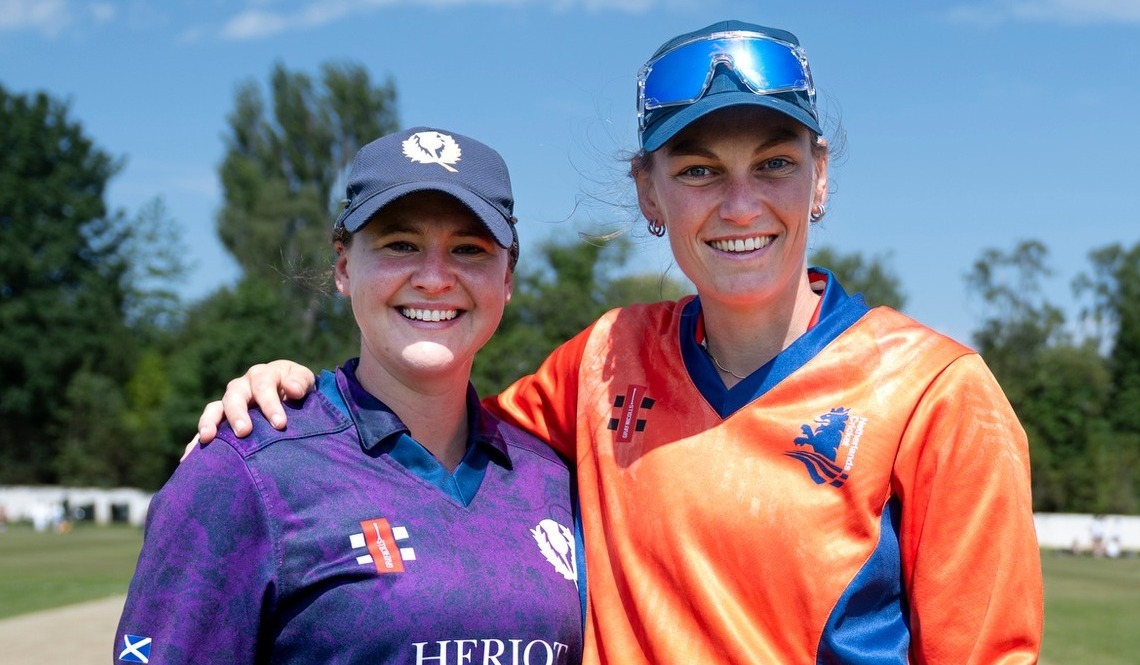
The second ICC Women's Emerging Nations Trophy starts in Ajman on 12 November, and it is the closest thing yet to the model this article argues for. The tournament has grown from eight teams to ten and, for the first time, five Full Members (Bangladesh, Ireland, Pakistan, Sri Lanka and Zimbabwe) join five Associates (the Netherlands, Papua New Guinea, Scotland, Thailand and the UAE). The ICC calls it "an important step in providing more meaningful international competition for emerging teams."
Scotland, the UAE and PNG face Ireland and Sri Lanka in Group A. Defending champions Thailand and a near full-strength Netherlands meet Pakistan, Bangladesh and Zimbabwe in Group B. A Super Six follows, with the final at the Karwan Sports Club Cricket Ground on 25 November. Last year four teams finished level on points in Bangkok and Thailand won on net run rate. This year the gap is bigger, and that is the point.
Watch the cricket, but watch the commercial side too. Ten national teams in one emirate for a fortnight is real inventory. The question is whether anyone sells it.
The 19 Yards Take
- Nine teams. Zero wins. That was the Associates' record against Full Members at the 2026 men's T20 World Cup, months after Nepal and the UAE beat Test nations in bilateral series. The talent is there. The fixtures are not. Every Full Member tour that passes an Associate without stopping is a chance to grow the game, thrown away.
- Three players. That is how many Nepal cricketers hold the top central contract, worth roughly US$1,000 a month, in a team whose fans packed the Wankhede at a World Cup. The demand is real. Until boards can tell sponsors exactly what it costs to make their best 20 players full-time, the next generation will keep picking other careers.
- One brand. One ladder. Capricorn Group backs Namibia's entire women's pathway, from a girls' schools league to the national team, for N$1.2 million over two years. That is a deal a local company can sign this year. Most Associates have simply not built the package to ask for it.
Ajman will produce a few upsets and a few heavy defeats. Neither settles anything. What matters is whether the teams playing there have 20 more fixtures and three more sponsors lined up by this time next year.
That is the kind of work we do across every level of the game: competition structure, fixture strategy, pathway design, rights and sponsorship packaging, and the commercial plan that pays for all of it. If your board, league or brand is trying to turn an Associate moment into a lasting model, talk to 19 Yards. The upset makes the headline. The calendar builds the business.