Two Finals. Two Winners. Two Weeks That Reminded Me Why This Work Matters.
Category: Commercial Strategy | Read time: 8 min read
19 Yards sponsored Ghent Gladiators in the EUT20 Belgium and three teams in Sweden's Nordic Smash T20 Cup, including eventual champions Vasteras United. Both leagues won their inaugural titles in June 2026. This is a personal reflection on what two weeks in Belgium and Sweden revealed about cricket's genuine development opportunity across Europe, and why building proper infrastructure matters more than any single result.
Two Finals. Two Winners. Two Weeks That Reminded Me Why This Work Matters.
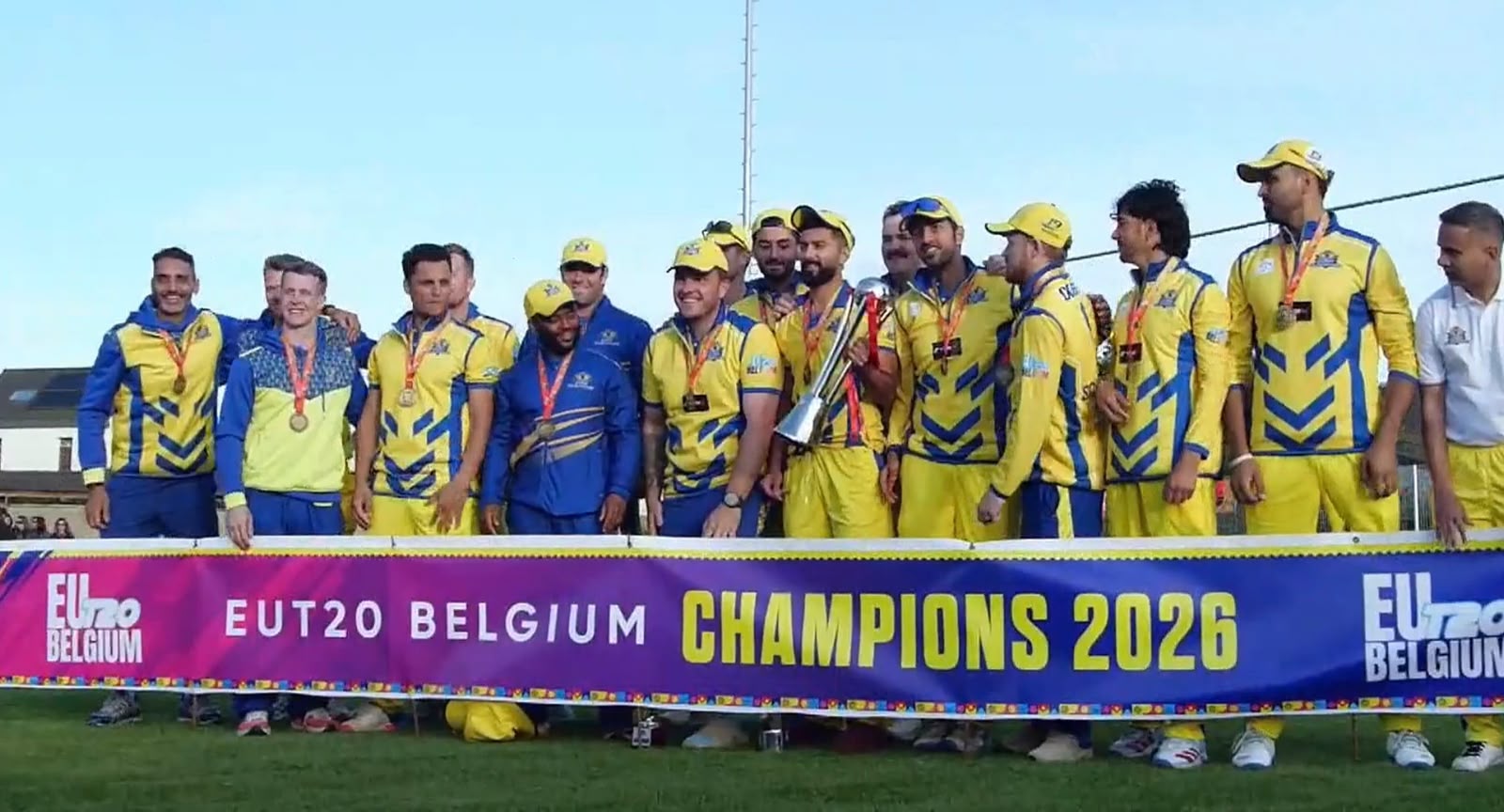
I spent the first two weeks of June in Belgium and Sweden, watching cricket take root in places it has never properly existed as a professional sport before. 19 Yards sponsored the Ghent Gladiators in the EUT20 Belgium. We sponsored Vasteras United, Stockholm City, and Malmo Mavericks across the Nordic Smash T20 Cup. Ghent won in Belgium. Vasteras won in Sweden.
I have built a career around the commercial logic of moments like this, and that logic is real. Broadcast reach into India through Sony Sports and FanCode. Genuine international playing talent. A development structure that puts local players on the same pitch as the names they have grown up watching. Being early in markets that nobody else has taken seriously yet is how durable positions get built. I would make that case in any boardroom.
But if I am honest, that is not what these two weeks were actually about for me.
What I Watched in Belgium
Europe has the playing population and the communities around it. What it has lacked is access to proper infrastructure, grounds, coaching, broadcast distribution, and a credible competitive structureGhent Gladiators won the EUT20 Belgium final on 14 June, chasing 179 and getting there in the final over with Ali Khan, an associate nation player from USA, named as Man of the Match. Temba Bavuma was the icon signing for Ghent. The squad had been through real upheaval before the final even started, players added and removed through the draft right up to early June, the kind of disruption that makes an inaugural season genuinely fragile. By the final, it had become a team.
What stayed with me was the 2-4-4-6 development model the league requires, Belgian players in every starting XI alongside the international signings. I watched cricketers who have spent years playing club cricket around Brussels, Ghent, and Antwerp with no platform remotely close to this, sharing a dressing room and a result with players who have international caps. That is the part of the EUT20 that matters most to me, more than the broadcast numbers. It is a structural commitment to actually growing the Belgian game, not just renting Belgian soil for a tournament.
What Watching Sweden Meant
The Nordic Smash T20 Cup ran from 15 to 20 June in Stockholm. I had sponsorship relationships with three of the six teams, which meant I spent the tournament not knowing which result I actually wanted. Vasteras beat Stockholm United in the semi-final, then beat Stockholm City in the final under DLS to take the inaugural title.
I need to be honest about something here that matters more than the sponsorship logic. This was a full circle moment, two weeks where I was completely in my element, watching the sport I love being built from the ground up in a country where it has barely had a foothold before. Cricket Sweden has built its base through club cricket and the European pathway rather than marquee events, and seeing that translate into a properly competitive, broadcast tournament with genuine international names attached was something I had been hoping to witness for a long time, long before I ever thought about it commercially.
The Opportunity I Actually See Here
The reason I keep coming back to Belgium and Sweden, beyond the two weeks I just spent there, is what they represent for cricket's development across Europe. Both countries have meaningful South Asian communities and growing club cricket scenes, but until this year, neither had the infrastructure, the broadcast relationships, or the investment to turn that grassroots interest into something professional and visible.
That is the real opportunity. Europe has the playing population. What it has lacked is access to the kind of infrastructure, proper grounds, broadcast distribution, coaching expertise, and a credible competitive structure, that turns a community sport into a development pathway. The EUT20's mandatory local player inclusion and the Nordic Smash's six-team domestic structure are both attempts to build that infrastructure deliberately rather than waiting for it to arrive on its own. When a Belgian or Swedish club cricketer gets to share a pitch with an international player for the first time in their life, that is not a marketing moment. It is the beginning of a pathway that did not exist for them twelve months ago.
Building that infrastructure properly, the grounds, the coaching, the broadcast relationships, the competitive structure, is what turns a one-off tournament into a genuine development pipeline. That is what I think both of these leagues are attempting, and it is why I think they deserve serious, sustained attention rather than a one-season verdict.
Why Both Things Are True
I sponsored these teams because the commercial fundamentals made sense and because I believe in what these leagues are trying to build for European cricket's long-term development. I also spent two of the best weeks I have had in this work in a very long time, watching it happen in person. I do not think 19 Yards would be doing this properly if either of those things was missing.
Both leagues are early. Inaugural seasons are not where you judge whether something is sustainable, that judgment comes in years three, four, and five, when the infrastructure either deepens or stalls, when the broadcast numbers either hold or fade, and when the local pathway either produces a player who goes on to something bigger or quietly disappears. What I can say honestly, having watched both finals, is that the cricket was good enough, and the development infrastructure was serious enough, to deserve that longer judgment.
Ghent Gladiators won in Belgium. Vasteras United won in Sweden. Both finals were the product of leagues trying to build something real: genuine pathways for local players, proper infrastructure, and a credible route from club cricket to a professional stage. I went into these two weeks for commercial reasons I would defend anywhere. I came out of them reminded why I do this work at all.
If you want to think through what cricket's infrastructure development in Europe could mean for your organisation, let's start a conversation at 19 Yards.